
























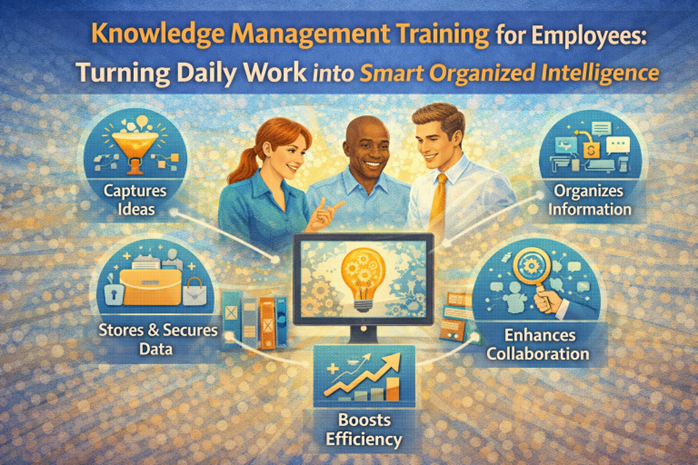
Work is a source of useful knowledge every day. Teams solve problems, do activities, and learn from their experiences. Knowledge management training for employees helps them convert these activities into useful knowledge. Organizations can retain useful knowledge and make it accessible to all. This provides clarity and understanding in all aspects and areas of work.
- Understanding Knowledge in Everyday Work: Each and every task at work is significant if looked at in a proper manner. Employees tend to realize and understand the patterns, solutions, and useful knowledge in their activities. This gives a sense of purpose beyond the completion of tasks. Work is no longer defined as a set of tasks. Work becomes a source of knowledge. This makes the employees aware and encourages them to write down useful knowledge for better decisions in the future.
- Turning Actions into Information: Activities can be moulded into information in a very simple manner by taking small steps towards documentation. By writing small summaries of activities, saving the most important activities, and sharing the results of activities, a simple flow of information can be created. Over time, a very strong collection of information can be created.
- Developing Practical Knowledge Skills: Employees develop and become stronger in their knowledge management training skills for employees. Skills include clear writing, organizing data, and making connections. As employees develop these skills, they become more efficient in managing information. This development is beneficial for teamwork and provides a continuous system in which knowledge is easily manageable.
-
- Building a Culture of Sharing: Employees of a culture of sharing thrive well in an environment where knowledge is permitted to grow organically. Sharing of ideas, solutions, and experiences is conducted without any apprehensiveness. Knowledge builds trust within the team. Sharing becomes a continuous culture where knowledge is distributed across the organization to support employees in their roles.
- Using Simple Tools for Better Access: Tools play a significant role in the management of knowledge in an effective manner. Simple and easy platforms allow employees to store and access information in a timely manner. When the tool aligns with the requirements of daily activities, employees use the tool on a regular basis. This enables the updating of information in a timely manner.
- Learning Through Daily Experience: Each experience gained in the workplace has significant value if utilized in the right manner. Employees can look back and think about the tasks that have already been completed. They can write down the learnings from such experiences. This will actually help them understand the best ways of dealing with a similar experience in the future.
- Making Knowledge Work: In order for the knowledge to work effectively, it must be easily understandable. It is therefore vital to ensure the use of simple and contemporary words. This will ensure that the employees are able to easily apply the knowledge they have. Once the knowledge is easily applied by the employees, it becomes efficient.
In conclusion, if knowledge is managed and shared correctly, work is transformed into organized intelligence. This means employees have more clarity, and decisions become more effective. A successful knowledge management program for employees is one that assists employees in using knowledge correctly and helps develop a continuous flow of learning. This approach strengthens everyday work and supports long-term growth.