

























The fundamentals are crucial for many American fishermen to succeed on the ocean. Even with the best rod, reel, and bait, you may still be disappointed if you don’t have dependable fishing knots and a well-adjusted line. Knowing how to string a fishing pole correctly and comprehending basic fishing knots will significantly improve your performance and confidence, regardless of your level of experience.
Any angler can follow this blog because it simplifies everything in an understandable and useful manner.
Why Fishing Knots Matter More Than You Think
Angling process fishing knots could be considered a bigger factor than their importance was thought to be. They decide the amount of strength, the behavior of the lure, and whether the setup will hold the fish that is still fighting. A poorly tied knot is among the most common reasons for fish loss with anglers. Most break-offs take place at the knot instead of at the line itself.
Knots are vital in the fishing process and using the right knot for the right situation is not unimportant. It helps to keep the line unbroken, gives you better control over the fish, and is less irritating too. The good news is that only a few trusted knots are needed for the majority of freshwater and seawater situations.
Essential Fishing Knots Every Angler Should Know
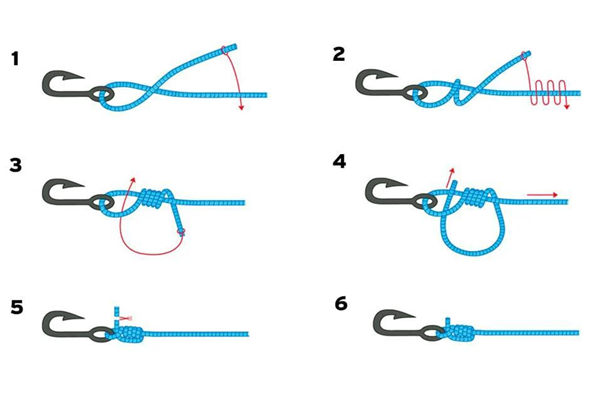
- Improved Clinch Knot
This knot is one of the most popular among the American anglers when it comes to fishing. It is strong, simple, and attaches very well to hooks, swivels, and lures. With monofilament and fluorocarbon lines it works perfectly, and it also makes it the best choice for beginners and everyday fishermen.
- Palomar Knot
The strongest and most reliable knot, Palomar, is known among bass fishermen of its power and strength. It works great with the braided line and is very easy to tie even when it is rather dark. If you want a knot that can withstand almost every condition, then this one is for you.
- Uni Knot
The Uni knot is a multi-purpose knot that can be used for tying hooks, joining lines, or making loop knots. Many anglers go for it due to its reliability with various line types and fishing methods. Once learned, it can take the place of several other knots in your kit.
- Loop Knot
The major benefit in using a loop knot is that the lure gets more movement freedom which results in a more natural presentation in the water. This type of knot is mainly used with crankbaits, jerk baits, and soft plastics, where the action is very essential.
Once you have acquired the knots that let you do this in the easiest way, you will not have to worry about your fishing place and technique anymore.
Common Knot Mistakes to Avoid
Even if the knot is correct, it still needs to be tied right. One of the most common mistakes is not moistening the line before pulling tight which causes friction and the knot gets weaker. Another mistake is being in a hurry which leads to uneven wraps or slipping. Spending a few extra seconds making it perfect and tight could be the difference between losing the fish of a lifetime and not.
How to String a Fishing Pole the Right Way
Correctly stringing a fishing pole goes hand in hand with tying strong knots. A line properly set on the rod helps in smooth casting, accurate lure control, and better management of the line.
Step 1 Start at the Reel
The first thing to do is to open the bail of the spinning reel or disengage the spool of the baitcasting reel. Hold the line on the spool by using a simple arbor knot and then close the bail.
Step 2 Follow the Guides Carefully
Begin from the guide closest to the reel and go all the way until the tip of the rod; pass the line through each guide. Be careful that the line indeed goes through all the guides as otherwise, problems may arise with casting.
Step 3 Keep Light Tension
While you are wrapping the line around the spool, keep your fingers applying light tension. This will prevent loose coils from forming and therefore the chances of forming tangles will be smaller.
Step 4 Correctly Fill the Spool
Never completely fill the reel. Always leave a very small space around the spool’s edge which will help in letting the line flow smoothly during casting and good to prevent wind knots.
Now you have done the spooling and threading of the line. It is now you can tie the chosen knot and connect it with the lure or hook.
Matching Knots and Line Types
Fishing lines have different behaviors regarding the way they are treated. Monofilament is the most forgiving and requires only the basic knots, while some caution has to be used with fluorocarbon because its stiffness makes it hard to use. Braided line can also be done with knots like Palomar or double Uni for extra safety. Knowing these differences will ensure that your setup operates according to your specifications.
Final Thoughts
Fishing knots and the correct way of stringing the reel are skills that every American angler has to learn. These basics impart confidence, increase success, and consequently make the fishing trip a pleasurable one.
The days of fishing will be less hassle and more fun if you pay attention to strong knots, proper line setup, and careful technique. Whether you are fishing in a local lake, river, or coastal waters, these fundamentals will always be there for you.